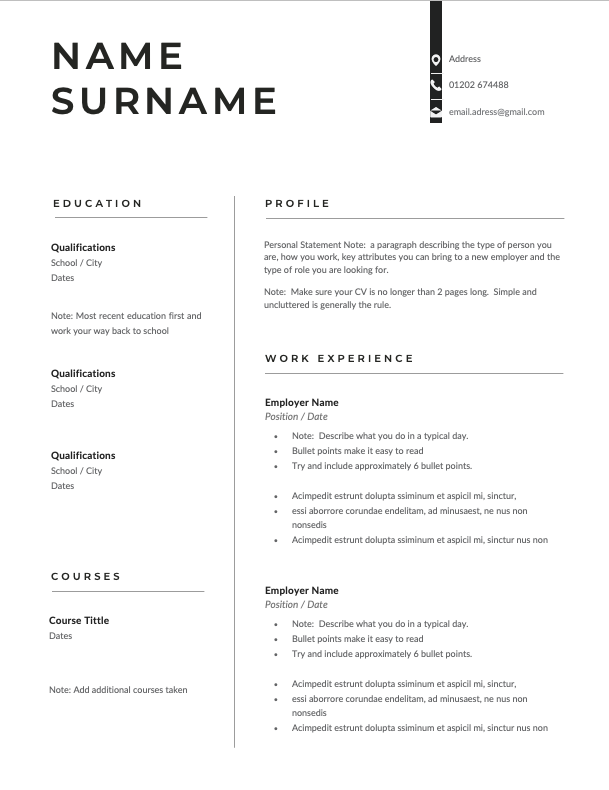
How do I put together my CV?
Putting together a CV can seem like a daunting thing to do. It is important to make the CV easy to read and to include relevant information that an employer would be looking for.
On this page we have a compiled a step-by-step guide for you to follow along with a template to download.
WHAT IS IT?
WHY DO I NEED IT?
WHAT SHOULD IT LOOK LIKE?
INCLUDE THE FOLLOWING:
MAKE SURE YOUR CV PRESENTS THE BEST POSSIBLE VERSION OF YOU -
KEEP IT CLEAR, CONCISE AND RELEVANT
1. Unnecessary Details About Your Life
There are a few personal details you should include on a resume: full name and contact information, including email, phone number and address. But beyond that, personal details should be kept to a minimum. If the prospective employer wants to know more than the minimum, they will ask you or figure it out for themselves. Your age, race, political affiliation, anything about your family members, and home ownership status should all be left off your resume. The exception to the rule: If you’re looking to work for an organisation closely tied to a cause, you may consider including your race, political party, or religious beliefs.
2. Your Work Responsibilities as a Lifeguard When You Were 16 …
Don’t include information that will not advance you in your work goals. That includes hobbies and irrelevant jobs you held many years ago. Unless you’re an undergraduate student or a freshly minted professional, you should limit your work history to professional experience you’ve had in the past 10 to 15 years.
3. A Headshot
It is illegal for employers to discriminate against job candidates based on appearance, so attaching a headshot can put employers in an awkward position and many people who do include a headshot are often not doing themselves any favours anyway.
4. Salary Expectations
Most job candidates feel uneasy discussing salary requirements. For good reason: Giving a number that’s too high or too low can cost you the job. You should keep it out of your
application materials entirely, unless the hiring manager asks for it. If they specifically ask for it, you should give them a range and that should be reserved for the cover letter and not put on the resume. If you have the option, save that discussion for a later stage of the interviewing process, ideally once the interviewer brings it up.
5. Lies
This should really go without saying, but career coaches and resume writers alike report that the line between embellishment and fabrication is often crossed by job applicants — and that they’ve seen it cost their clients jobs. One of the most common areas in which people fudge the facts is the timeline of their work history. Whether it’s using false information to cover a blemish or exaggerate success, there’s no room to lie on your resume. No matter how minuscule the chance is that you’ll be caught, you should always represent yourself as accurately as possible.
6. Things That Were Once Labeled “Confidential”
In many jobs, you will handle proprietary information. Having inside information from your positions at previous employers might make you feel important — but if you use
that information to pad your resume, chances are it will raise a red flag.
7. If You Were Fired From a Job — and What You Were Fired for
Your resume should put you in a positive light. Including that you were let go for poor performance, stealing from the company, or any other fault of your own will have the exact opposite effect. Leave out information about a situation that positions you negatively, such as ‘I got fired’ or ‘I mishandled funds.’ Anything that suggests you used poor judgment in your current or former job is not a good thing to have on your C.V.
Following this advice does not violate the rule about lying (No. 5). If you’re asked to explain why you left a job, you need to bite the bullet and be straightforward, but until then, make sure you’re putting your best foot forward.
8. Overly Verbose Statements
There is a pretty fine line between selling yourself and overselling yourself. Too many resumes overstate the importance of job responsibilities. Keep your flair for the dramatic to a minimum, so resume readers can get a picture of what your real responsibilities were with your past or current company.
9. “References Available Upon Request” and Your Objective
The age-old “references available upon request” has become archaic. You should have solid references lined up from the get-go, so when the hiring manager asks for them, you’re ready to share them.
And 9 mistakes people really have made on their CVs...
We can't wait to hear from you.
| Mon - Fri | 9am - 5.30 |
|---|---|
| Sat - Sun | Closed |
Snr. Consultant, Perm Recruitment
Director, Temporary Recruitment
Consultant, Perm Recruitment
Retired and Loving Life